Stellara
Built on Tarn, Conductor and COSMIC · For Defense
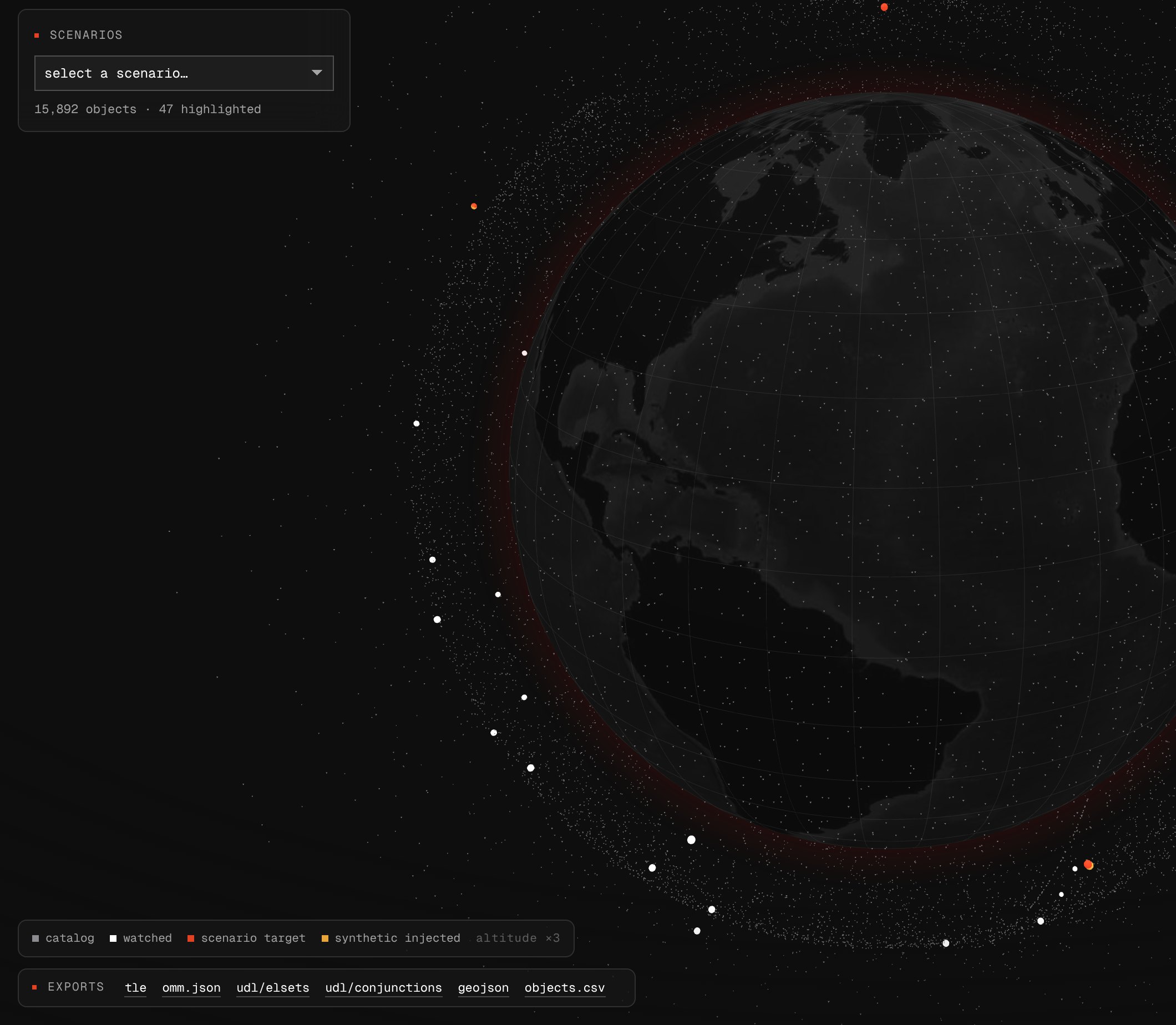
Deterministic space threat synthesis. Stellara screens every object in low Earth orbit for rendezvous and proximity operations, close approaches, unexplained maneuvers and degraded data, and raises each threat call with its math attached: the inputs, the model versions, the rule that tripped, a confidence score with its parts, and the chain of evidence behind the attribution. The same tracks give the same call every time, on hardware that fits under a desk.
A threat call you can take to a commander.
The point is not the dashboard. Stellara is a thin application over the Frontier Foundry stack, so every number behind a call is computed by a verified algorithm, recorded in a hash-chained ledger and replayable.
-
Every LEO Track, Screened
Each watched object goes through one COSMIC space-threat screen: maneuver residuals, conjunction geometry, pattern-of-life deviation and cross-source agreement, evaluated against the mission's criteria.
-
Alerts With the Dossier Attached
Every alert carries its features, the rule that tripped, a three-way classifier vote, a confidence score broken into its components, and an attribution traced through the evidence graph.
-
Same Tracks, Same Call
The criteria are inlined into the pipeline, so the pipeline hash covers the rules a decision was made under. Re-run the inputs and the call comes back identical.
-
Algorithms Proven in Four Languages
Every feature that reaches a classification is a COSMIC function proven identical in Python, Rust, C and C++. Nothing is computed in the browser.
-
Three Workflow Modes
Analyst-in-the-loop with four-eyes approval, human-on-the-loop with a veto window, or automated for whitelisted classes only. The hosted application refuses what the controls refuse.
-
A Ledger That Proves Itself
Every harvest is an Iceberg snapshot on Tarn and nothing is deleted. Every alert acted on is a governed write to a hash-chained ledger with post-quantum (ML-DSA) checkpoints.
Milliseconds, on one workstation.
Measured on a single workstation in October 2026 against the captured catalog. A typical requirement for this kind of screen is seconds.
-
16 ms
SGP4 propagation of all 15,892 objects in low Earth orbit
-
41–44 ms
Screen from data arrival to decision, 47 watched objects
-
46 ms
The same screen run from the hosted application, with lineage
-
71 ms
Ledger verification: hash chain plus ML-DSA post-quantum checkpoints
Stellara runs today as a sandbox on one workstation. The catalog is a capture rather than a live feed, the threat scenarios are deterministic and synthetic and are labelled as synthetic on every row, and the classification criteria are a placeholder for the taxonomy each mission writes for itself. Imagery and video are not yet wired in.
See it inside your environment.
Stellara walkthroughs are available under NDA. Schedule a deployment assessment to see the globe, the alert queue and a full dossier, and to replay a threat call from its inputs.