CyberAudit
Built on Kundi and Limni · For Banking, Government and Defense
Source-code security audit for institutions that cannot send their code anywhere. CyberAudit checks a codebase against a local knowledge base of about 290,000 CVEs, makes every finding survive an adversarial challenge before it is reported, and hands your security officer a report that opens with a verdict. In production it runs on Frontier Foundry's own system, entirely on your hardware: no code egress, no cloud APIs, no per-scan fees.
See CyberAudit work.
Select an interface, or its expand control, to inspect it full-screen.
Product and service names are blurred.
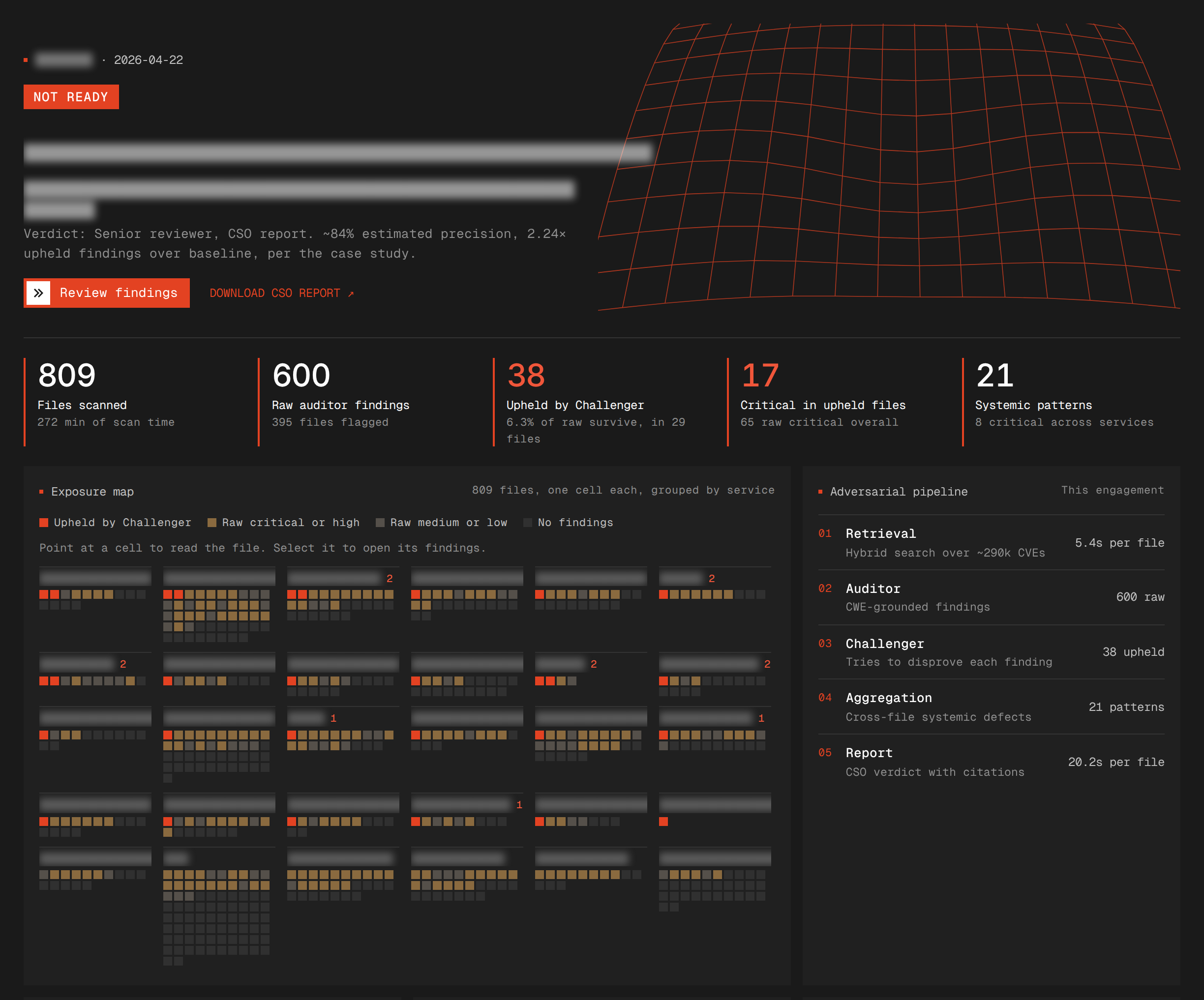
Every finding has to survive a challenge.
The Auditor and Challenger run on Kundi, governed by Limni. Reviewers mark every finding true or false positive before it is final. Generic code review flags whatever looks risky. CyberAudit grounds each finding in real vulnerabilities, then tries to disprove it. Rule-based recognizers for well-understood patterns, such as JWT algorithm confusion, SQL parameterization, and hard-coded fallbacks, settle those cases outright, so judgement is spent where it is needed.
-
01 · Auditor
Reads the codebase and proposes candidate findings, each tied to the vulnerability classes and real CVEs it resembles in the local knowledge base.
-
02 · Challenger
Tries to knock every candidate down before it reaches you: false-positive triage, recognition of defenses already in the code, schema checks, and rejection of anything ungrounded.
-
03 · Overnight Diagnostics
An optional deeper pass for architectural defects that file-by-file scanning misses, with a triage queue and a health signal for the engagement.
A report your security officer can sign.
A deep scan ends in a 25–30 page report written for the CSO, plus the machine-readable findings behind it.
-
A Verdict First
An executive summary that opens with NOT READY, CONDITIONAL, or READY, then the findings by severity and CWE.
-
Every Finding Explained
Per-finding cards with the evidence, the fix, and cross-references to OCC 2023-35, NYDFS Part 500, the FFIEC IT Handbook, and NIST SP 800-53.
-
What It Dismissed, and Why
Near-miss analysis of serious findings the Challenger demoted, and the false positives it rejected, so a reviewer can disagree with the tool.
-
Machine-Readable Too
Structured JSON findings per file, a run log, and a systemic-patterns file that lifts defects repeated across the codebase.
On an 809-file production codebase.
A financial-crime compliance platform in Go, Python, Rust, and TypeScript, about 250,000 lines, audited twice with only the pipeline changed between runs. Runtime was the same both times.
-
2.24×
more findings upheld after adversarial review than the previous pipeline, same codebase
-
~30% → ~84%
estimated precision of upheld findings
-
0
lines of code, embeddings, or results that leave your environment
-
$0
per-scan or API fees
A self-hosted command-line tool and services on Linux or macOS, on a workstation-class GPU or Apple Silicon machine, including fully air-gapped installs. CyberAudit is a scanning aid for audit teams, not unattended assurance: reviewers mark each finding true or false positive, and that ledger calibrates the next scan to your codebase.
See it inside your environment.
CyberAudit walkthroughs are available under NDA. Request a briefing to see a scan, the Challenger's reasoning, and a full CSO report run against a codebase you choose.