Kelda
Built on Tarn · For Asset Management, Banking
Kelda is the market-data layer of the Frontier Foundry stack. A client integrates once, with one API and one response shape, then switches vendors with a query parameter. Everything Kelda collects is stored on Tarn, so the data survives a vendor outage, a rate limit, a cancelled subscription, or a provider quietly rewriting history.
One API. Every number traceable.
Kelda can say where every number came from, when it was observed, and who may see it.
-
One Envelope, Any Vendor
Quotes, history, profiles, news, search and economic series come back in a single response shape, so changing vendor does not mean changing code.
-
32 Vendors Out of the Box
Kelda comes with 32 market-data vendors out of the box.
-
Your Private Sources, First Class
Add a source as native Rust, as a few lines of configuration with no code, or as a sidecar in any language in your own repository. Each one gets the same caching, metrics, health checks and console.
-
Collection on a Schedule
A fresh deployment starts collecting without waiting for a request, and every harvest is recorded, so the data you hold grows on its own.
See Kelda work.
Click a window, or its green button, to read it full-screen.
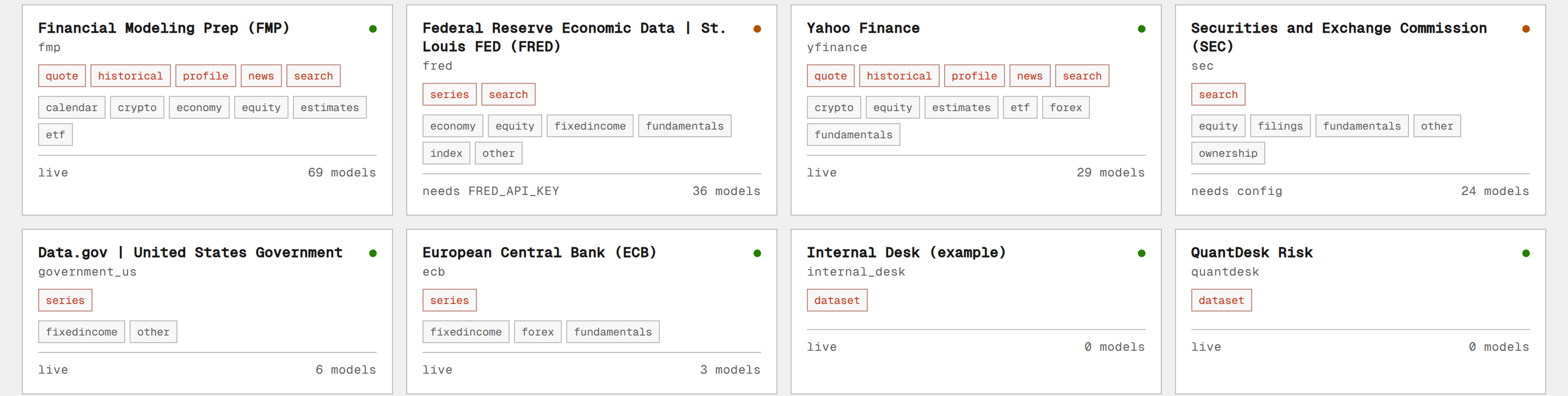
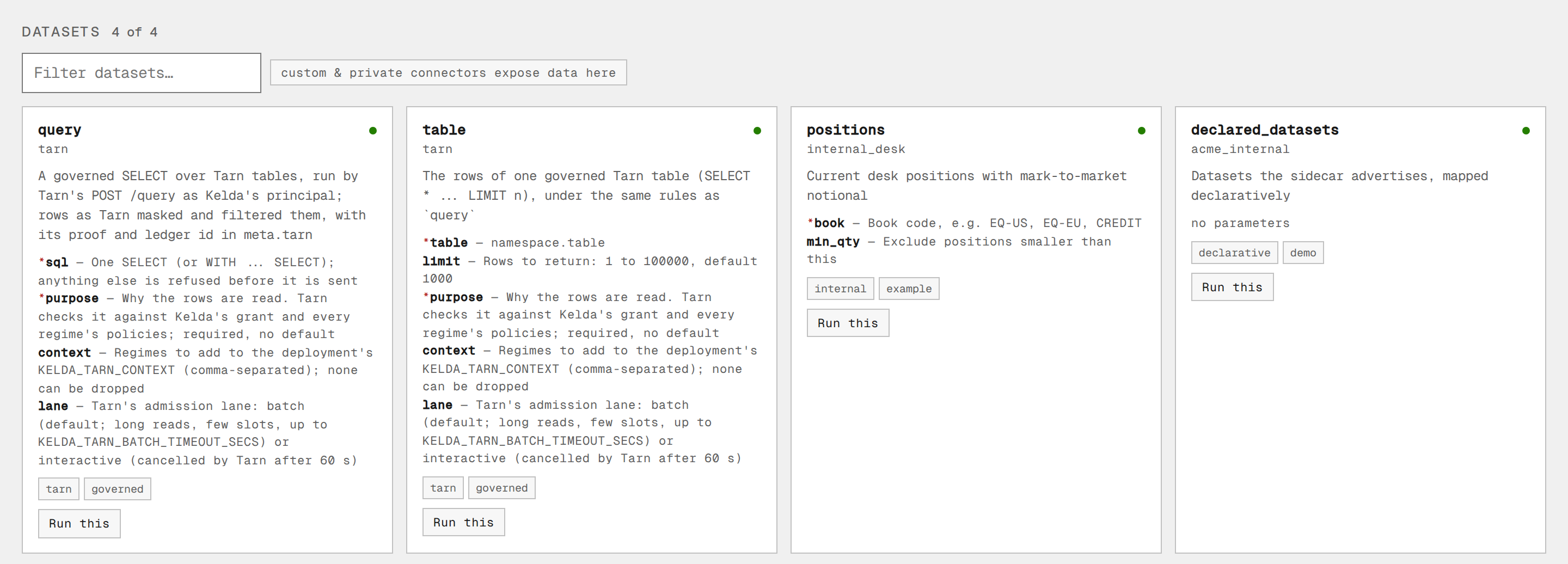
Nothing deleted. Nothing overwritten.
Kelda keeps no second store. Tarn owns the catalog, the keys, the policy engine and the hash-chained ledger.
-
Versioned by Default
Every harvest is a table snapshot and every record is a locked, content-addressed object. Earlier versions stay readable.
-
Every Sensitive Read Is a Ledger Entry
Confidential and personal records are read through Tarn’s policy gate under a declared purpose, and the record comes back with its ledger id.
-
Erasure That Is Actually Erasure
Personal data is encrypted under a key for each data subject. Erasure destroys the key and writes a ledger entry naming what became unrecoverable.
-
It Verifies Itself
One command walks Tarn’s chain, runs its catalog verification, re-checks every object Kelda points at, and fails loudly on any mismatch.
The data layer, and only that.
Kelda acquires, normalizes and stores data. Provenance only holds if acquisition happens in one place, so the rest of the work lives elsewhere.
-
Kelda
Acquisition, normalization, storage, retention, provenance and erasure. It does not compute, decide or schedule work.
-
COSMIC
Verified deterministic algorithms, pinned by content hash. It does not fetch data, hold state or decide.
-
Conductor
Binding, scheduling, queuing, lineage and decisions. It does not store market data or implement algorithms.
-
SOC 2 Type II
Frontier Foundry is SOC 2 Type II certified.
See it inside your environment.
Live Kelda walkthroughs in your environment are available under NDA. See your own private source plugged in beside the vendors, and a governed read return its proof.